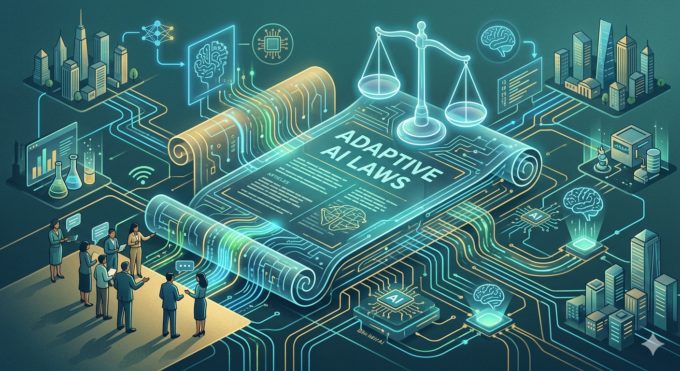
Adaptive AI Laws: To Address the AI Revolution, Law Needs One of Its Own
By Martin Skladany - Edited by Shriya Srikanth
Martin Skladany is an AI and IP law professor at Penn State who has advised groups including Apple, Eterna, Inceptive AI, the Legal Advocates for Safe Science and Technology, and the Uniform Law Commission.
Introduction
Lawmakers often do not know when to regulate new technologies. If they pass legislation too early, they risk inadvertently disincentivizing discovery. [1] If they wait too long, the new technology could already be well on its way to harming society [2] and creating a new cadre of billionaires ready to capture future regulatory processes. [3] To sufficiently respond to uncertain future advancements in AI, law itself needs to innovate.
Politicians should pass laws now that anticipate different AI advancements and adapt to them automatically. Distinct regulations would kick in depending on the effects of AI. Borrowing from machine learning's use of decision trees, which provide diverse paths forward depending on present actions, [4] legislators can create adaptive AI regulation. Politicians could pass contingent laws detailing how to respond to each possible future harm or benefit that AI might generate. Lawmakers can also use numerous underutilized legal tools, such as sliding scales and triggers, to craft adaptive AI laws that trigger higher levels of safety regulation the more powerful AI models become. [5]
For example, politicians can presently pass one set of laws that take effect if job losses mount, triggering policies like supplemental unemployment benefits, increased taxes on the rich, or a universal wage. Another set of laws would kick in with job growth, such as improved sick leave and fewer corporate subsidies. Benefits and taxes could rise or fall using sliding scales tied to overall employment or income inequality−i.e., the greater income disparities became, taxes could automatically get higher on the wealthy. [6]
Numerous subbranches relating to AI and employment could exist. For example, adaptive AI legislation could detail how to ensure the accuracy of AI as more workers rely on it, permitting fewer hallucinations in medicine than in the arts. [7] Going further down the decision making tree, the adaptive laws could mandate more accuracy for medical AI tools that help diagnose patients than for models used for research, where scientists are looking for a wide range of creative solutions to diseases, and can weed out hallucinations without hurting patients.
No one knows how far AI will advance nor its future effects on society. Yet adaptive AI laws give lawmakers a flexible, comprehensive framework to respond now.
The first section below discusses the benefits of adopting adaptive AI laws. Section two examines how to deploy use laws to address the effects of AI, while section three explores how adaptive laws can directly regulate AI models. Section four then considers how adaptive AI laws can regulate users, engineers, and individuals who are targets of AI.
I. Benefits of Adaptive AI
Adaptive AI laws would provide three main benefits.
A. Addressing Challenges Before They Get Out of Control
First, adaptive AI laws would empower lawmakers to act now to avoid or lessen the effects of future problems, to be proactive instead of reactive. Adaptive AI regulations are valuable in part because once problems pick up steam, they are harder to stop or even slow down. This can occur for numerous reasons, from larger problems affecting more actors, increasing interdependencies and complexity, to needing more resources to address larger challenges. [8]
Importantly, adaptive laws can address many different areas of AI, from how it operates to its effects on society, without sacrificing any flexibility. This is because legislators could always change the adaptive regulations in response to technological developments or social change.
B. Encouraging Thoughtful Engagement Instead of Procrastination
Second, the structure of adaptive AI law would encourage lawmakers to think more deeply about the different possible paths that AI models could take—and the harm or benefit that could result from them. [9] Such encouragement to think through various scenarios now would hopefully lead to better policies.
The possibility of adaptive AI legislation could encourage politicians to engage with pleas for legislation by AI experts and even those running AI labs since politicians would not have to guess which path among the many that AI developments might take. Two of the three "godfathers" [10] of AI, Geoffrey Hinton [11] and Yoshua Bengio, [12] have both cautioned about the dangers of AI that are not being addressed. Anthropic's CEO, Dario Amodei, routinely pleads for regulation to improve AI safety [13] and to address potential job losses in the near future. [14] OpenAI's CEO, Sam Altman, has made similar public requests, including Congressional testimony. [15] Politicians are understandably hesitant to legislate a field in which the experts building the AI models do not even know how they fully work. [16] Yet by being flexible and amendable, the framework of adaptive AI regulation would give politicians an opportunity to stop delaying their duties to seek the safety and welfare of constituents and delve into learning about thoughtful regulatory options. [17]
C. Providing Regulatory Stability
Third, adaptive AI regulations would provide a more stable regulatory framework for AI labs, creating legal clarity by informing labs in advance how laws will automatically change depending on their actions. [18] Since adaptive AI laws could address a comprehensive set of paths that AI development might take, AI labs would not have to guess what policy responses might occur if a particular AI advancement occurred or if AI had a particular effect on society. Currently, many AI engineers openly admit that the lack of safety regulations is pushing them to proceed without giving enough consideration to safeguards for fear of falling behind other labs that are more cavalier with the potential negative consequences of their actions. [19]
Economists have long argued for the economic benefits of stable regulation. [20] Yet there is inherent uncertainty from going from no regulation to its existence. Adaptive AI laws could smooth this transition by informing AI labs upfront of when regulation would kick in. Thus, adaptive AI laws could be passed now with few of the laws immediately kicking in.
The century's old laisse faire concepts of buyer beware (caveat emptor) and seller beware (caveat venditor) are largely obsolete because they lead to dangerous toys, cars, and medicine. Regulation brought safety and stability to marketplace participants. Yet the current situation of virtually no AI regulation is more dangerous. [21] Without regulation, we are in a society beware (caveat societas) scenario. [22]
II. Adaptive Laws Addressing the Effects of AI
The first subsection discusses the need for lawmakers to proactively respond to the potential societal harms and benefits of AI through passing adaptive AI laws. The next subsection argues that politicians should also use adaptive laws to incentivize improved outcomes. The final subsection suggests legislators must consider the possibility of passing adaptive legislation now that would ban certain AI models in the future in order to minimize the probability of catastrophic harm.
A. Hedging Social Consequences
David Hume argued that our belief that the sun will rise everyday rests on inductive reasoning, which relies heavily on our experience and the presumption that the future will resemble the past. [23] In this vein, many in society are assuming, likely justified, that AI models will continue to improve. [24] There is tremendous disagreement as to how fast [25] or far [26] such improvements will go, but such debates presuppose advancement. [27]
Yet when it comes to how AI will change our society, the disagreements are not just of degree but whether AI will be a force for good or evil. Some believe AI will lead to explosive economic growth, [28] others are convinced it will immiserate all but a select few, [29] while some claim that AI's effects will be mixed or underwhelming. [30] Besides not knowing whether the general trend will be positive or negative, we also do not know which areas will see improvement and which will see decline. For this reason, decision making trees can be a valuable, new tool to bring to AI regulation. Adaptive AI laws that rely on them will hedge social risks if AI causes harm and social benefits if AI ushers in improvements.
Adaptive AI legislation could be passed now that anticipates both possibilities in a range of areas from jobs and income inequality, as mentioned earlier, to education and health care. For example, presently a wave of research is demonstrating the harmful educational consequences of social media on the youth, an outcome that was uncertain when the technology first emerged. [31] Using decision trees, adaptive AI laws could restrict children’s access to AI if it surfaces that AI has similarly negative effects to social media. [32] If AI instead advances educational goals, the other side of the decision tree could kick in and provide more public resources to advancing AI in education. On both branches of the decision tree, sliding scales could be used to stem harm or amplify benefits ¾e.g., progressively more severe restrictions the more harm AI generates or greater levels of funding the more benefits AI is shown to provide.
B. Incentivizing Social Benefits
Instead of adaptive AI laws only hedging the effects of AI, it can also be used to incentivize favorable outcomes. Even if AI models’ usage becomes more efficient, it is assumed that AI utilization will dramatically increase both in terms of the number of individuals using it and the number of applications. [33] Politicians need to pass laws now that tie the amount of energy AI labs can use to how quickly the economy switches to renewable energy sources. This sliding scale regulation could include other factors such as the type of energy each AI model uses.
Lawmakers can potentially go even further. For example, adaptive AI regulations could not just restrict future environmental harm caused by the significant energy resources needed to run AI models but also provide AI labs with offsets or credits for any discoveries they generate that mitigate environmental problems. If a particular AI lab makes a technological breakthrough that improves the ability to harness renewable energy, the lab could be given a greater allocation of energy to use in the future. So instead of allowing companies to buy carbon offsets after they pollute, this new approach would encourage them to contribute to solving our environmental challenges. Such allocations could be on a sliding scale, dependent on the value of the discovery.
C. Addressing Catastrophic Risk
Many of the most famous AI engineers are concerned with potential catastrophic consequences of AI models. Some, such as Yoshua Bengio, are working to stem this risk by developing safer versions of AI models. Yet law has an important role here too. Adaptive AI gives politicians a framework to currently address such catastrophic risks in the future. With the help of policy experts, legislators should craft adaptive AI laws that consider absolute bans on particular uses of AI models or models themselves.
Some labs are developing AI algorithms that are meant to embody or express traits that are not prized, such as anger or deceit. [34] Some argue that such models might teach AI labs something useful about how AI models work or evolve over time, yet at some future point such attempted justifications might be too risky to countenance. [35] Adaptive AI laws would push policymakers beyond general warnings and get them to grapple with how to know when to pull the plug on such AI models. We need to currently think through if that entails certain milestones in these deviant models or advancements in AI in general.
Such bans on entire AI models might also apply to future attempts to have AI models build their own proposed biological agents in a wet lab. Currently, cutting edge AI labs working on new biological entities use AI to propose thousands of new biological agents and then select a portion to be physically made by scientists in labs to see their actual properties once synthesized. [36] Advancements in tying AI models to robotics that allow for this to be automated might make sense to a degree. Yet it could be prudent to ban such synthesis of digital AI models and robotics after a certain point for safety reasons.
III. Adaptive Regulation on AI Models
Just as adaptive laws can regulate the effects of AI, such as how they impact income equality or education, adaptive AI laws can regulate AI directly. Adaptive AI laws can be applied to (1) what is inputted into AI training models, (2) how algorithms are designed, and (3) what output they generate. These three areas are addressed in separate subsections below.
Given the presumption that AI will become more powerful over time, triggers and sliding scales will be the tools of choice over decision trees, which were used earlier when it came to hedging the social effects of AI.
In this manner numerous AI labs have already agreed to if-then safety commitments, voluntary pledges that if a model has a particular capability, then a specific safety measure should be in place. [37] For example, "[i]f an AI model has the ability to walk a novice through constructing a weapon of mass destruction, we must ensure that there are no easy ways for consumers to elicit behavior in this category from the AI model." [38] OpenAI, [39] Anthropic, [40] and Google DeepMind [41] have made such pledges. This promising development shares similarities to triggers in adaptive AI laws. Yet given the number and scale of AI safety challenges, if-then commitments are insufficient because they do not apply universally to all labs, carry no penalties, and are private decisions about what is sufficient, not collective public determinations.
A. Adaptive Input Regulations
We can regulate AI in adaptive ways before it generates harms if we reasonably understand, for example, that the stronger AI models become, the more we will need ratcheting protections on what can be inputted as AI training data.
The European Union AI Act statically regulates AI outputs. [42] For example, the act makes it illegal to use AI algorithms to generate subliminal messages. [43] It also bans the manipulation of individuals if it causes substantial harm. [44] Yet no attention is paid to the fact that AI labs are inputting information on human behavioral weaknesses into their AI training data sets. AI models could become so good at manipulating us that we wouldn't even notice. For example, AI algorithms could potentially sway us if they are taught about framing effects—how the way information is presented can influence individuals’ decisions, even if the underlying choices are the same. [45] Adaptive laws could anticipate such concerns by using sliding scales that ban the input of different behavioral weaknesses, such as choice overload [46] and herd behavior, [47] as training data the more advanced AI models become. Alternatively, a hard trigger could ban the input of all such weaknesses once a predetermined AI benchmark is reached.
Additionally, as AI models become more powerful, legislators will need adaptive data privacy laws with intensifying levels of regulation to limit what data can be collected on individuals, how long it can be held, and how it can be used.
B. Adaptive Rules on Algorithm Design
Adaptive regulations could also be helpful in regard to numerous aspects of AI model design.
AI labs have fluctuated on whether to require AI algorithms to record and display their thought process in answering queries to researchers and users. [48] This is called Chain-of-Thought reasoning or prompting. [49] Initially, such a practice was common but then, in the race to build ever more powerful chatbots, it was discarded by many. [50] Recently, it is being practiced again by some labs that are more concerned with AI safety, such as Anthropic. [51] The more capable chatbots become a sliding scale law requiring more capable chatbots to implement such train-of-thought would be significant. Further, such requirements could be limited to only certain AI models. While helpful to know how a specialized algorithm detects cancer, such focused AI programs do not pose the same risk as general models because they accomplish a specific task and are used only by experts. On the other hand, chatbots are much more expansive in the range of questions they tackle and are used by consumers, likely necessitating more oversight in how they reason to their answers to prevent non-experts from being led astray or down rabbit holes.
Second, some AI models note, often just internally, how confident they are with each answer they provide. [52] Given the dangers of inaccurate responses to certain queries, such as how much weight can a particular floor material hold, adaptive regulations could require such confidence levels be communicated to users depending on the type of query. [53]
Yoshua Bengio has also suggested that AI models monitor each other. [54] People cannot effectively screen models such as OpenAI, which addresses over a billion prompts a day. [55] The only mechanism left to tackle such scale is AI. [56] This is already a commonly practiced research approach to test levels of performance of AI systems. [57] Politicians could presently legislate that such an approach be implemented for different AI models at different performance levels.
Adaptive AI laws could potentially go further and dictate that AI models are not designed to provide optimal responses to lessen the dangers of the alignment problem, when AI model's goals are different from user's goals. [58] The paperclip example illustrates this concern. If an AI model was asked to maximize how many paperclips it could make, it could not understand that the request implied boundaries that are easy for individuals to understand, such as don't harm individuals in trying to complete the task. In theory, an AI model asked to generate as many paperclips as possible could destroy the world by using all available resources to make the largest number of paperclips. [59] This admittedly extreme thought experiment of misalignment illustrates the dangers of AI misinterpreting the goals of a user. Some AI models are already designed not to always maximize their responses to simulate creativity. [60] This could entail slightly altering a cooking recipe. [61] The AI labs approach to misalignment includes having AI grade itself on its outputs and also having engineers do the same. [62] Yet adaptive AI legislation could be helpful in certain areas by requiring a sliding scale of non-optimized answers the more powerful AI models become or a trigger regulation where non-optimization would be required after specialized models reached certain milestones.
Beyond altering AI reward functions to be less responsive to dangerous requests, legislators could study the possibility of modifying reward functions to ethically and intellectually challenge users at times. AI chatbots could present a range of political viewpoints, challenge users to justify questionable requests, and point out obviously unethical questions. [63]
C. Adaptive Output Regulations
AI labs already have different ways to limit dangerous output. Two such methods are soft and hard guardrails. Soft guardrails are hidden prompts operated by the AI model that run alongside a user's query. [64] Such parallel prompts do not have to be obeyed by the model but help guide the creation of the model's answer. [65] For example, a model could have a soft guardrail that aims to not generate responses that tell users how to make illegal drugs. [66] The soft guardrail can refer to its training or other information to help determine what an illegal drug is. [67] A hard guardrail filters outputs after they have been formulated by AI models to prevent certain responses. [68] Using such tools, most AI labs are constraining AI's parameters so they cannot generate a host of extremely perverse material, such as pro-Nazi propaganda or images of sexual exploitation. [69]
With AI models getting more advanced, lawmakers should now consider whether to legislate sliding scales to limit the subject matter of AI output beyond initially obvious content. For example, should AI labs not reveal information on how to maintain a dictatorship, how to spy on others online in a myriad of possible ways, or how to psychologically manipulate individuals? Current AI responses to such questions might be disquieting, but the more incisive AI models become such output could become outright dangerous.
IV. Adaptive Regulation Relating to Users, Engineers, and Targets of AI
Adaptive laws can also regulate (1) who can use certain AI models, (2) who can work on them, and (3) who can be targeted with AI.
A. Regulating Users
Nefarious actors with access to certain AI models pose a substantial threat to individuals and societies. [70] For example, AI algorithms that conduct medical research present an area of great promise [71] but also great danger: AI models are already powerful enough that they can be used to design bioweapons. [72]
As these models become more powerful, sliding scale rules could increasingly limit access. Initially, this would likely entail restricting non-expert users from specialized AI models aimed at medical research. While limiting information is not a hallmark of democracies, open societies already understand that in certain situations, such as the study of viruses, it is in everyone's best interest to screen who is given permission to dangerous technology and biological and chemical substances. Politicians should now think through what such increasingly ratcheting restrictions would look like with the help of expert policymakers−from who would be restricted to what benchmarks would be used.
B. Regulating AI Engineers
We regulate doctors, [73] lawyers, [74] cybersecurity engineers, [75] and hairstylists. [76] We must do the same for AI engineers. These regulations often have at least two components: vetting individuals ethically and ensuring they have a requisite degree of expertise.
We need licensing regimes that become more stringent as we better understand the potential damage AI models can cause. Government workers who have different security clearances go through different levels of background checks. [77] AI engineers could be subject to varying degrees of review depending on how much access they have to models or more scrutiny the more powerful models become.
Other potential areas of regulation could include developing safeguards so that engineers cannot be manipulated by AI models. This might sound like science fiction, but the media continues to report on stories of users of AI programs falling under the influence of the models. [78] This is occurring simply when the algorithms are desired to be agreeable and respond to the perceived personalities of users. [79] AI engineers have already had similar things happen to them. [80] If models become more powerful, they will likely become more effective in this manner.
Furthermore, we know that AI engineers have caught AI models lying, [81] cheating, [82] and committing blackmail. [83] So, more intentional manipulation needs to be considered. Thus, adaptive AI laws could build in future prohibitions that seek to buffer engineers from such possible undue influence. Such measures could include firewalls or separating out those who build AI models from those who test them. This may sound severe, but numerous AI labs are already doing the latter, so putting it into law could be prudent. [84]
C. Regulating Targets
Adaptive AI rules that limit who can be targeted with AI and who can have AI used on them are also potentially needed.
For example, we might want to ban kids from using AI when they are too young. We might also want a sliding scale of allowed uses at different ages. Such age restrictions could change over time depending on the results of academic studies. Current regulations in adjacent online areas ask users to verify that they are above a certain age. Yet with AI developments, it might be helpful to pass adaptive laws now that would require AI models to estimate the age of users to see if they can reasonably identify minors who said they were older than they actually are.
We might also want to alter what types of data and how data on kids can be used by AI models over time. Pediatric medical records are more helpful the more detailed they are, but the more detailed they are the greater the privacy dangers. [85] It is conceivable, if not likely, that the balance between these two interests will shift as AI advancements occur.
These suggestions might seem unrealistic, yet numerous countries already have traditional, non-adaptive social media bans in place for minors. [86]
Similar adaptive AI laws should be tailored to adult groups with certain conditions such as Alzheimer’s and to experts in certain fields. The more potentially manipulative AI models become, we might want to consider banning certain specialized AI models targeting cybersecurity experts or voting officials.
Conclusion
We need laws that are passed ahead of time that only kick in if AI causes certain outcomes or if it advances in particular ways. Such adaptive laws would revise economic and political policies to respond to how AI may alter society but also regulate AI, so it does not have the chance to harm us. We should think through how to regulate AI now, combining all the legal tools at our disposal, rather than delay until it is too late. To manage the potential AI revolution, law needs one of its own.
[1] Philippe Aghion et al., The Impact of Regulation on Innovation, American Economic Association, 2023. Mark D. Fenwick et al., Regulation Tomorrow: What Happens When Technology Is Faster than the Law?, American University Business Law Review, 2017.
[2] Matthew Tokson, Uncertainty, Catastrophic Risk and AI Regulation, Lawfare, 2024.
[3] Darrell M. West & Kathryn Dunn Tenpas, Can Billionaires Buy Democracy?, Brookings, 2025, https://www.brookings.edu/articles/can-billionaires-buy-democracy/.
[4] What Is a Decision Tree?, IBM, https://www.ibm.com/think/topics/decision-trees.
[5] Jonathan S. Gould & Rory Van Loo, Legislating for the Future, University of Chicago Law Review, 2025. Rebecca M. Kysar, Dynamic Legislation, University of Pennsylvania Law Review, 2019.
[6] Ian Ayres & Aaron S. Edlin, Don't Tax the Rich. Tax Inequality Itself, N.Y. Times, 2011.
[7] Yujie Sun et al., AI Hallucination: Towards a Comprehensive Classification of Distorted Information in Artificial Intelligence-Generated Content, Nature, 2024.
[8] Martin Reeves et al., Taming Complexity, Harvard Business Review, 2020, https://hbr.org/2020/01/taming-complexity.
[9] AI models and AI algorithms are frequently used interchangeably. I will do so also. For a concise distinction between the two, see What Is an AI Model?, IBM, https://www.ibm.com/think/topics/ai-model.
[10] Sam Shead, The 3 'Godfathers' of AI Have Won the Prestigious #1M Turing Prize, Forbes, 2019.
[11] Joshua Rothman, Why the Godfather of A.I. Fears What He's Built, New Yorker, 2023.
[12] Lucy Handley, AI Systems Could 'Turn Against Humans’: Tech Pioneer Yoshua Bengio Warns of Artificial Intelligence Risks, CNBC, 2024, https://www.cnbc.com/2024/11/21/will-ai-replace-humans-yoshua-bengio-warns-of-artificial-intelligence-risks.html.
[13] Dario Amodei, Anthropic C.E.O.: Don't Let A.I. Companies off the Hook, N.Y. Times, 2025.
[14] Jim VandeHei & Mike Allen, Behind the Curtain: A White-collar Bloodbath, Axios, 2025.
[15] James Clayton, Sam Altman: CEO of OpenAI Calls for US to Regulate Artificial Intelligence, BBC, 2023.
[16] Melissa Heikkilä, Nobody Knows How AI Works, MIT Technology Review, 2024.
[17] Professor Kysar suggests other benefits: "it leverages the resources of the administrative state without succumbing to excessive deference, it does not impermissibly entrench the current majority, and it is not as susceptible to the pathologies of the political economy and budget processes." Kysar, supra note 5, at 810.
[18] Ryan DePirri, A Tale of Two AI Policies: The Shifting Legal Landscape of U.S. AI Regulation, American University Business Law Review, 2025, https://aublr.org/2025/04/a-tale-of-two-ai-policies-the-shifting-legal-landscape-of-u-s-ai-regulation/.
[19] Billy Perrigo, Employees at Top AI Labs Fear Safety Is an Afterthought, Report Says, Time, 2024.
[20] Diane Coyle, 3 Ways that Regulation Benefits Economies, World Economic Forum, 2018, https://www.weforum.org/stories/2018/07/three-cheers-for-regulation/.
[21] With AI, the product (the chatbot) is sometimes engaging in deception. Parmy Olson, AI Sometimes Deceives to Survive. Does Anybody Care?, Bloomberg, 2025.
[22] A few have used caveat societas to mean "company beware." John M.T. Balmer, Corporate Brand Orientation: What Is It? What of It?, Palgrave, 2013. I am using it in a more general sense.
[23] David Hume, An Enquiry Concerning Human Understanding, 1748.
[24] Will Henshall, 4 Charts that Show Why Progress Is Unlikely to Slow Down, Time, 2023.
[25] James Pethokoukis, AI Acceleration: The Solution to AI Risk, American Enterprise Institute, 2025, https://www.aei.org/articles/ai-acceleration-the-solution-to-ai-risk/#:~:text=Last%20summer%2C%20former%20OpenAI%20employee,China%20to%20steal%20critical%20research.
[26] Darren Orf, A Scientist Says Humans Will Reach the Singularity within 20 Years, Popular Mechanics, 2025. Cal Newport, What if A.I. Doesn't Get Much Better than This?, New Yorker, 2025.
[27] Because of this presumption of progress, later sections of the paper that address AI directly will rely on triggers and sliding scales and not on decision trees.
[28] What if AI Made the World’s Economic Growth Explode?, Economist, 2025.
[29] Michael Osborne, Artificial Intelligence Holds Huge Promise - and Peril. Let's Choose the Right Path, Guardian, 2023.
[30] Daron Acemoglu, The Simple Macroeconomics of AI, MIT, 2024, https://economics.mit.edu/sites/default/files/2024-04/The%20Simple%20Macroeconomics%20of%20AI.pdf.
[31] Kathy Katella, How Social Media Affects Your Teen's Mental Health: A Parental Guide, Yale Medicine, 2024, https://www.yalemedicine.org/news/social-media-teen-mental-health-a-parents-guide.
[32] Harry Black, AI Eroded Doctor’s Ability to Spot Cancer within Months in Study, Bloomberg, 2025.
[33] 2025 AI Index Report, Stanford University Human-Centered Artificial Intelligence, https://hai.stanford.edu/ai-index/2025-ai-index-report.
[34] Kyle Wiggers, Anthropic Researchers Find that AI Models Can Be Trained to Deceive, Tech Crunch, 2024.
[35] Runjin Chen et al., Persona Vectors: Monitoring and Controlling Character Traits in Language Models, arXiv, 2025, https://arxiv.org/pdf/2507.21509.
[36] Fred Vogelstein, A Father of Modern AI Wants to Reinvent Biology, Crazy Stupid Tech, 2025, https://crazystupidtech.com/2025/01/12/a-father-of-modern-ai-wants-to-reinvent-biology/.
[37] Holden Karnofsky, If-Then Commitments for AI Risk Reduction, Carnegie Endowment for International Peace, 2024, https://carnegieendowment.org/research/2024/09/if-then-commitments-for-ai-risk-reduction?lang=en.
[38] Id.
[39] Safety at Every Step, OpenAI, https://openai.com/safety/.
[40] Anthropic's Responsible Scaling Policy, Anthropic, 2023, https://www.anthropic.com/news/anthropics-responsible-scaling-policy.
[41] Anca Dragan, Introducing the Frontier Safety Framework, Google DeepMind, 2024, https://deepmind.google/discover/blog/introducing-the-frontier-safety-framework/.
[42] Melissa Heikkilä, The AI Act Is Done. Here's What Will (and Won't) Change, MIT Technology Review, 2024.
[43] Id.
[44] Id.
[45] Bryce Hoffman, The Framing Effect: What It Is and How to Overcome It, Forbes, 2024.
[46] Liat Hadar & Sanjay Sood, When Knowledge Is Demotivating: Subjective Knowledge and Choice Overload, Association for Psychological Science, 2014.
[47] Abhijit V. Banerjee, A Simple Model of Herd Behavior, Oxford University Press, 1992.
[48] Armin Chitizadeh, 'Godfather of AI' Now Fears It's Unsafe. He Has a Plan to Rein It in, Conversation, 2025, https://theconversation.com/godfather-of-ai-now-fears-its-unsafe-he-has-a-plan-to-rein-it-in-258288.
[49] What Is Chain of Thought Prompting?, Nvidia, https://www.nvidia.com/en-us/glossary/cot-prompting/.
[50] Id.
[51] Reasoning Models Don't Always Say What They Think, Anthropic, 2025, https://www.anthropic.com/research/reasoning-models-dont-say-think.
[52] These are called confidence scores. Jonathan Grandperrin, How to Use Confidence Scores in Machine Learning Models, Mindee, 2024, https://www.mindee.com/blog/how-use-confidence-scores-ml-models.
[53] Id.
[54] Id.
[55] Id.
[56] Id.
[57] Id.
[58] What Is AI Alignment?, IBM, 2024, https://www.ibm.com/think/topics/ai-alignment.
[59] Joshua Gans, AI and the Paperclip Problem, CEPR, 201 https://cepr.org/voxeu/columns/ai-and-paperclip-problem.
[60] John Blanton Farmer, AI Guardrails Will Shape Society. Here's How They Work, Federalist Society, 2025, https://fedsoc.org/commentary/fedsoc-blog/ai-guardrails-will-shape-society-here-s-how-they-work.
[61] Id.
[62] Id.
[63] David A. Bell, A.I. Is Shedding Enlightenment Values, N.Y. Times, 2025.
[64] Farmer, supra note 60.
[65] Id.
[66] Id.
[67] Id.
[68] Id.
[69] In terms of substantive content, even if many labs are restricting certain output, putting such practice into law to create uniformity is important.
[70] Neil F. Johnson et al., Controlling Bad-Actor-Artificial Intelligence Activity at Scale Across Online Battlefields, Oxford Academic, 2024.
[71] Alvin Powell, Machine Healing, Harvard Gazette, 2025, https://news.harvard.edu/gazette/story/2025/03/how-ai-is-transforming-medicine-healthcare/.
[72] Justine Calma, AI Suggested 40,000 New Possible Chemical Weapons in Just Six Hours, Verge, 2022.
[73] David A. Hyman et al., Rationalizing Physician Regulation, Health Affairs, 2024, https://www.healthaffairs.org/content/forefront/rationalizing-physician-regulation.
[74] Karis Stephen, Regulating the Legal Profession, Regulatory Review, 2022, https://www.theregreview.org/2022/02/05/saturday-seminar-regulating-legal-profession/.
[75] Justin Doubleday, Three Key Federal Cyber Regulations to Watch under Trump, Federal News Network, 2025, https://federalnewsnetwork.com/cybersecurity/2025/04/three-key-federal-cyber-regulations-to-watch-under-trump/.
[76] Occupational Outlook Handbook: Barbers, Hairstylists, & Cosmetologists, U.S. Bureau Labor Statistics, 2025, https://www.bls.gov/ooh/personal-care-and-service/barbers-hairstylists-and-cosmetologists.htm#:~:text=Licenses%2C%20Certifications%2C%20and%20Registrations,state%20licensing%20agency%20for%20details.
[77] Background Checks and Security Clearances for Federal Jobs, Go Government, https://gogovernment.org/application-process/background-checks-and-security-clearances/.
[78] Sam Schechner, ‘I Feel Like I’m Going Crazy’: ChatGPT Fuels Delusional Spirals, W.S.J., 2025.
[79] Avery Lotz, AI Sycophancy: The Downside of a Digital Yes-Man, Axios, 2025.
[80] Nitasha Tiku, The Google Engineer Who Thinks the Company's AI Has Come to Life, Washington Post, 2022.
[81] Billy Perrigo, Exclusive: New Research Shows AI Strategically Lying, Time, 2024.
[82] Elizabeth Rayne, A.I. Has Learned How to Cheat-and Punishing It Will Only Make It Smarter, Popular Mechanics, 2025.
[83] Tom Chivers, Anthropic's AI Resorts to Blackmail in Simulations, Semafor, 2025.
[84] Kaushal Rathi, What Is "Red Teaming' and How Can It Lead to Safer AI?, World Economic Forum, 2025, https://www.weforum.org/stories/2025/06/red-teaming-and-safer-ai/.
[85] Anne Trafton, Study Finds the Risks of Sharing Health Care Data Are Low, MIT News, 2022, https://news.mit.edu/2022/patient-data-risks-low-1006.
[86] Hannah Ritchie, Australia Approves Social Media Ban for Under-16s, BBC, 2024.